Investing vs. Saving
I remember looking forward to my first real job. I thought if I was going to make 50k salary, I would be taking home around $4000 a month and that meant I could save a lot of money. But the reality was that my take home pay check was under $3000. After paying student loans and rent and other expenses, there was very little to save.
SAVING
Let’s just say I saved $1000 a month and put it into a savings account. This is what a lot of people do when they start working. Why else would they call it a savings account if it wasn’t for saving? Most of these accounts give you around 1% interest. There are some banks that give more if you have a higher minimum balance etc. So let’s just say you found a great bank that gives you 2% interest. Here’s what it will look like 20 years later.
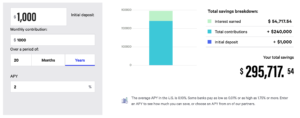
You contributed $240k and interests gave you $54k. But after inflation (at an average rate of 2.5%), this amount will be at a value of $178,141, i.e. less than even the amount you saved.
Investing
Now let’s look at the scenario where I invested this money in the stock market. Let’s look at a conservative scenario first. You put the $1000 every month into an index like S&P 500, which is an index that measures the performance of the 500 largest companies in US, you get an average return of 8%.
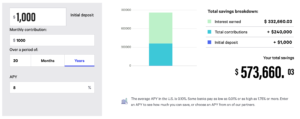
Your savings at the end of 20 years will be doubled. But this is if you invested in S&P 500. But based on your field of work and your own knowledge, you have a circle of competence or area of knowledge. If you are willing to research within this area, learn to evaluate companies and invest, you can easily achieve double the returns of S&P 500. Let’s see what that will look like.
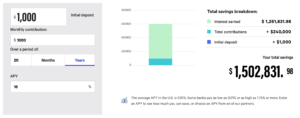
You are almost at 5 times the amount compared to leaving it in a savings account.
So far we looked at the difference between Savings vs Investing in 20 years. But the real difference and the power of compounding is visible when we look even further. Here’s an example of 40 years.
| Type | 20 years | 20 years with inflation | 40 years | 40 years with inflation |
| Savings | $295,717.00 | $178,141.00 | $733,652.30 | $269,712.00 |
| S&P 500 | $573,660.03 | $210,894.00 | $3,242,803.00 | $1,207,719.14 |
| Your investment | $1,502,831.98 | $559,700.65 | $30,729,622.93 | $11,444,652.63 |
You can really notice the difference between the savings approach and investing approach. Now you might wonder, if there is such a big difference, why don’t more people invest? Why didn’t I invest right out of college?
Because many look at investing as a big unknown with lots of risks, only meant for stock traders or financial experts. Some of these fears are valid as there are actual risks in putting your money in the stock market. But there are proven ways to reduce the risk. Once you learn how to value companies and stocks, determine successful companies by looking at their financials and management, you can reduce the risks and purchase great companies at a discount, and get great returns. My goal is to learn and apply this process while blogging about it so I can assess my own progress and help others who might want to go down this path as well.
Here are the calculators I used:
https://www.bankrate.com/calculators/savings/simple-savings-calculator.aspx
https://www.calculator.net/inflation-calculator.html